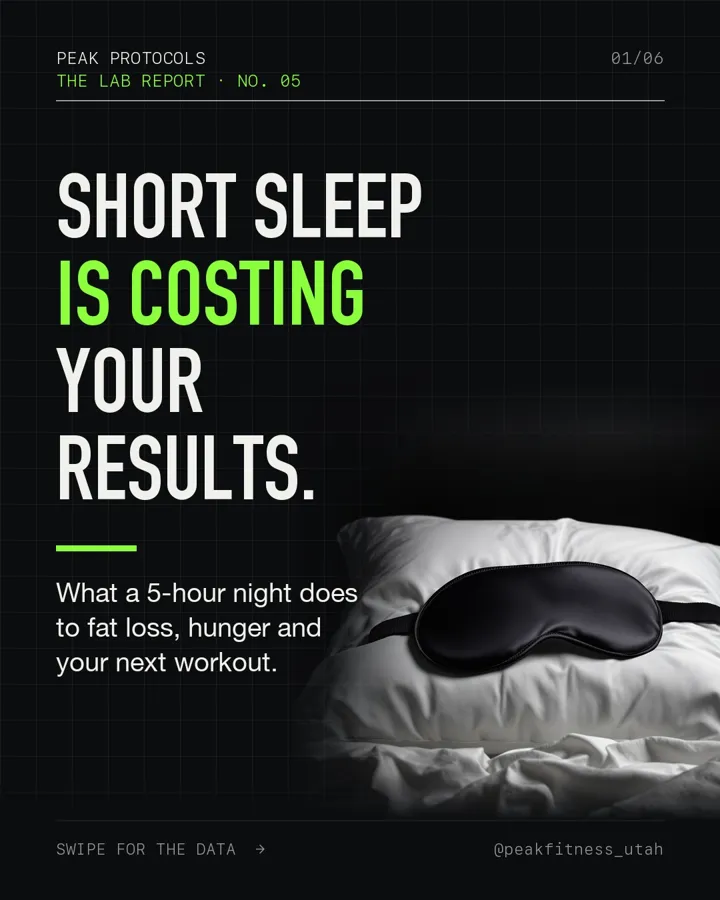
Every week our coaches at Peak Fitness in Orem read the actual studies behind a popular training or nutrition claim and boil them down to what holds up and what to do with it. Here's No. 05.
The evidence
- Fat loss: in a controlled trial, people ate the same diet for 2 weeks with either 8.5 or 5.5 hours in bed. Both lost about 6.5 lb, but the short sleepers lost 55% less fat (1.3 lb vs 3.1 lb) and more lean mass.
- Calorie intake: in a 2-week trial of 80 adults with overweight who usually slept under 6.5 hours, the sleep-extension group slept about 1.2 hours longer per night and reduced daily calorie intake by about 270 calories compared with the control group. Neither group was given a diet plan.
- Next-day training: across 69 studies, a short night (6 hours or less) cut exercise performance by about 7.6% on average. Strength, sprints, intervals, endurance and skill all dropped.
- Had a short night? Train early: morning sessions were largely unaffected, while evening ones dropped. And the longer you'd been awake, the bigger the drop.
The protocol
- →Dieting or training hard? Protect a full night in bed.
- →Short night coming? Train in the morning if you can.
- →If screens keep you up, try putting them away before bed.
Honest caveat
The fat-loss study was 10 sedentary adults over 2 weeks, and the sleep extension trial also ran 2 weeks. The performance studies were 89% men and varied a lot. Strong direction, smaller exact numbers.
Not medical advice. Always tired despite enough time in bed, or told you snore? Talk to your doctor.
Sources
- Nedeltcheva et al. Insufficient sleep undermines dietary efforts to reduce adiposity. Ann Intern Med, 2010
- Tasali et al. Effect of sleep extension on objectively assessed energy intake among adults with overweight in real-life settings: a randomized clinical trial. JAMA Intern Med, 2022
- Craven et al. Effects of acute sleep loss on physical performance: a systematic and meta-analytical review. Sports Med, 2022